How to Connect SAP to Salesforce: A Real-Time Integration Guide
Raúl Tovar
Last updated: September 2026
SAP to Salesforce integration means keeping account, order, and status data consistent between the ERP that runs the business and the CRM the sales and service teams actually live in, without a batch job standing between the two. Onibex OneConnect captures SAP business events at the application layer and streams them to Salesforce as they happen, so a sales rep or a service agent is looking at the same reality SAP already has.
I've built enough of these interfaces, and reviewed even more, to know this is one of the most common integration requests out there, and also one of the most commonly done badly. Usually not because anyone was careless, but because most SAP to Salesforce interfaces got built years ago as a batch job that made sense at the time and never got revisited.
Why does this integration usually break down in the first place?
The classic pattern looks like this: a nightly job pulls accounts, open orders, and order status out of SAP and pushes them into Salesforce, usually through Salesforce's Bulk API. It works, until the business starts asking questions the nightly cadence cannot answer.
A sales rep pulls up an account in Sales Cloud and sees an order status that is a day old. A service agent in Service Cloud is trying to resolve a complaint about a shipment and the order record has not caught up to what actually happened in SAP that morning. Credit exposure is a particularly painful example: if a customer's credit exposure changed in SAP an hour ago because of a new order, and the rep is still looking at last night's number, they can commit to something SAP would have flagged as a risk in real time.
None of this is a Salesforce problem or a SAP problem on its own. It is a timing problem created by the interface sitting between them.
How does streaming SAP business events into Salesforce actually work?
Instead of scheduling a batch pull, OneConnect captures the relevant SAP business events, an order created, an order status change, a credit exposure update, as application-layer events the moment they occur inside SAP ECC or SAP S/4HANA. Those events push out through an outbound HTTP RFC destination to the OneConnect Smart Gateway, which routes them to Apache Kafka or Confluent Cloud, and from there into Salesforce, typically landing as records through the Bulk API for larger volumes or as Platform Events when the goal is closer to instant delivery inside Salesforce itself.
The mechanism matters here more than the buzzword. Because the event is captured at the application layer, it already carries the business meaning of what happened, not just a row that changed in a table. An order status change event says "this order moved to delivered," not "a status field went from 3 to 5." That distinction is exactly what lets Salesforce automation, assignment rules, and reports react correctly without someone reverse engineering what a raw field value means.
Picture a distributor running S/4HANA where the sales team lives in Sales Cloud and support runs through Service Cloud. Today, order status updates land in Salesforce overnight. With event streaming, an order moving from open to shipped inside SAP shows up in the Salesforce record within seconds, so the service agent taking the "where's my order" call is looking at the same thing SAP is.
Does this only work one way, from SAP outward?
No, and this is the part people are usually most surprised by. The same event-driven pattern runs in both directions. A new customer or a new order created in Salesforce, by a rep closing a deal in Sales Cloud, for example, can flow back into SAP as a business event just as quickly, instead of waiting for a reverse batch job to catch up overnight. That means a rep can create an account and place an order in Salesforce in the morning, and by the time operations looks at SAP, the record is already there, not sitting in a queue for tonight's sync.
That bidirectional piece is what actually closes the loop. Without it, you end up with SAP staying the real source of truth while Salesforce slowly drifts out of sync in the other direction, which is the same stale-data problem, just pointed the opposite way.
What does the architecture actually look like?
It helps to see the shape of it rather than just read about it. At a high level, the flow is a single two-way path, not two separate one-way interfaces bolted together:
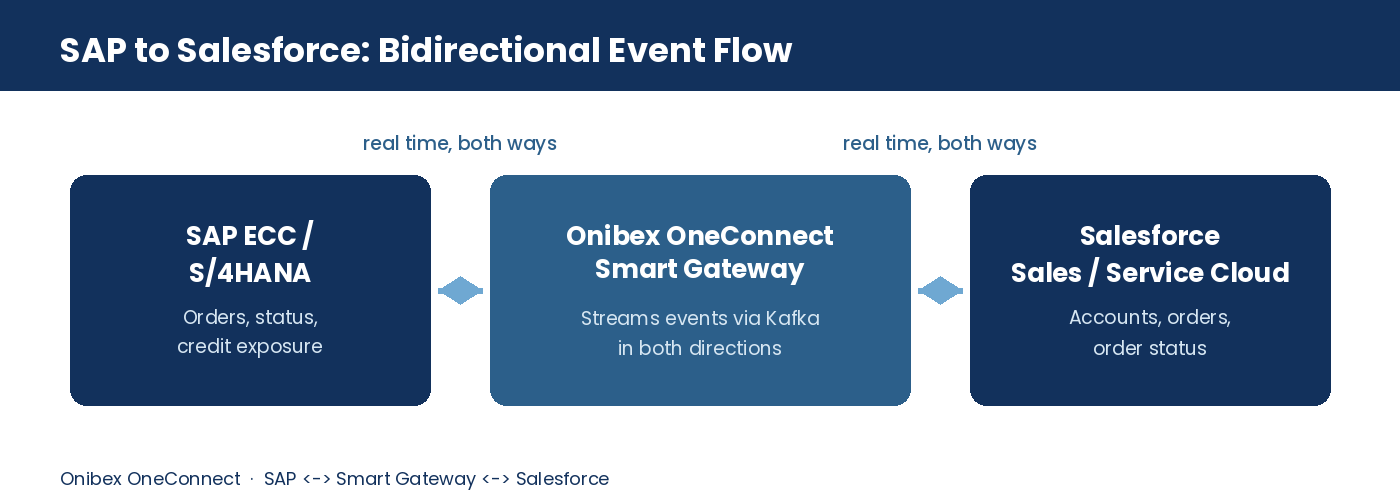
SAP ECC / S/4HANA and Salesforce Sales/Service Cloud, connected through the OneConnect Smart Gateway, streaming events in real time in both directions.
SAP pushes business events out (an order created, a credit exposure change, a status update) through the outbound RFC destination into the Smart Gateway, which streams them toward Salesforce. Going the other way, an account or order created in Salesforce is captured as an event and routed back through the same Gateway into SAP. One integration layer, one place to monitor, instead of a forward job and a separate reverse job that inevitably drift out of sync with each other.
| Today (batch job, nightly or scheduled) | With event streaming (Onibex OneConnect) | |
|---|---|---|
| Account and order data freshness in Salesforce | Hours old, depends on the last scheduled run | Seconds after the SAP event posts |
| Credit exposure visibility for reps | Last night's number | Current as of the last SAP transaction |
| New accounts or orders created in Salesforce reaching SAP | Waits for the reverse batch job | Seconds, through the same event pattern in the other direction |
| Adding a new event type (a new order status, for example) | New extraction logic, new mapping job | Configuration change |
| Failure visibility | Discovered when a rep notices stale data | Event-level, with the stream itself as the audit trail |
Worth being clear about scope. OneConnect is not a replacement for Salesforce's own automation and workflow tools. What it changes is how data moves between the two systems: instead of scheduling extraction jobs in either direction, the business events each system already generates get delivered continuously, so SAP and Salesforce stay in sync without anyone babysitting a batch window.
Frequently asked questions
Does data only flow one way, from SAP to Salesforce? No. The pattern works in both directions. An account or order created in Salesforce can flow back into SAP as a business event just as quickly, instead of waiting on a reverse batch job to sync it overnight.
Which Salesforce objects can receive streamed SAP data? Most commonly accounts, opportunities, orders, and order status, delivered either as standard records through the Bulk API for higher volumes or as Platform Events when near-instant delivery inside Salesforce matters more than batch efficiency.
Do we need custom ABAP development on the SAP side? No. OneConnect captures changes through standard SAP application-layer event frameworks (RAP, BOR, BTE, PPF), so modeling which objects to stream is a configuration task in SAP Data Modeler, not custom extraction code.
Which SAP versions does this support? SAP ECC and SAP S/4HANA. For SAP S/4HANA Cloud, the supported deployment is Private Edition.
What happens if Salesforce is unavailable when an event fires? The event lives on the Kafka topic regardless of whether the downstream consumer is available at that instant, so nothing is lost. Salesforce picks up where it left off once it reconnects, which is a meaningfully different failure mode than a batch job that simply did not run.
Where to start
If your team is fielding "why does Salesforce show something different than SAP" more than once a week, that's usually the signal this is worth scoping. Order status and credit exposure tend to be the easiest first objects to map end to end. Talk to the Onibex team about starting there.
Technical reference
Sink connector configuration for Salesforce lives in oneconnect-docs, Technical_Information. For Salesforce's own API documentation, see the SAP Help Portal for the SAP side of the interface.
Related reading: How OneConnect Captures SAP Business Events.
Last updated: September 11, 2026
About Onibex
Onibex is an SAP Silver Partner and Confluent Gold Partner building real-time SAP data hyperconnectivity for the enterprise. Its flagship platform, Onibex OneConnect, streams SAP ECC and SAP S/4HANA business events to Apache Kafka, Confluent Cloud, Databricks, Snowflake, and other destinations in real time. Onibex also maintains ASK (Agentic Semantic Knowledge), an open semantic-layer standard that grounds AI agents in governed, business-ready SAP data. Onibex is headquartered in The Woodlands, Texas.